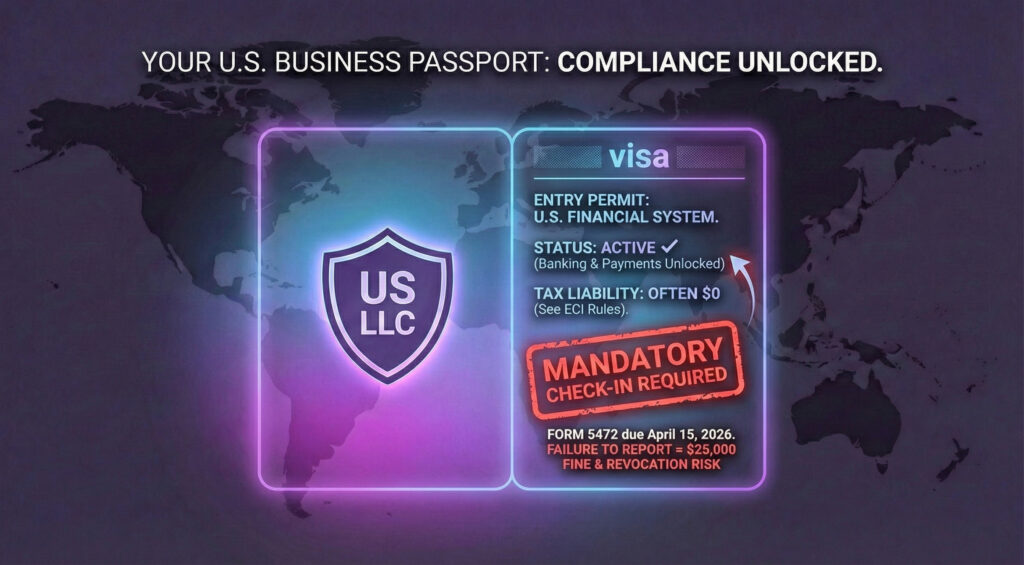
Taxes are the biggest source of fear for non resident founders forming a U.S. LLC. Many delay or avoid registering simply because they believe they will automatically owe U.S. taxes.
In reality, most non residents do not pay U.S. federal income tax if their LLC is structured correctly.
This guide explains exactly when non residents pay U.S. taxes, when they do not, and what rules matter in 2026.
The Biggest Tax Myth About U.S. LLCs
Forming a U.S. LLC does not automatically mean you owe U.S. tax.
The U.S. tax system focuses on where income is effectively connected, not where the company is registered.
This concept is called Effectively Connected Income.
What Is Effectively Connected Income
Effectively Connected Income refers to income that is:
Generated from U.S. based operations
Earned through U.S. employees or offices
Produced inside the United States
If your business does not meet these conditions, your income may be considered foreign sourced.
When Non Residents Do Not Pay U.S. Federal Income Tax
In most cases, non residents do not pay U.S. federal income tax if:
The owner lives outside the United States
The business is operated remotely
There are no U.S. employees
There is no physical office in the U.S.
Clients are located outside the United States
This applies to many:
Freelancers
Ecommerce sellers
SaaS founders
Digital agencies
When Non Residents Do Pay U.S. Taxes
Non residents may owe U.S. tax if:
They work physically inside the United States
They hire U.S. employees
They rent U.S. office space
They provide services inside the U.S.
Income is directly tied to U.S. activities
In these cases, tax obligations increase and professional guidance is required.
Single Member LLC vs Multi Member LLC
Tax treatment depends on ownership structure.
Single member LLC
Considered a disregarded entity
Income flows directly to the owner
Non residents usually owe no U.S. income tax if income is foreign sourced
Multi member LLC
Treated as a partnership
Each member reports their share
Filing requirements are higher
Required Tax Filings Even If You Owe Zero Tax
Even if you owe no tax, filings are still required.
Common filings include:
Form 5472
Pro forma Form 1120
Annual state compliance
Missing these can lead to penalties even when no tax is due.
State Taxes vs Federal Taxes
Some states have additional fees or reporting rules.
For example:
Wyoming has no state income tax
New Mexico has no annual report fee
Delaware has franchise taxes
Choosing the right state affects long term costs.
Why Proper Structure Matters More Than Ever
In 2026, compliance systems are more automated.
Payment platforms, banks, and tax authorities share data.
A clean structure helps:
Avoid audits
Prevent bank account reviews
Keep payment gateways active
Final Advice for Non Resident Founders
Do not fear U.S. taxes. Fear bad structure and missing filings.
With the correct setup:
Many non residents legally pay zero U.S. income tax
Compliance remains manageable
Global business becomes scalable
The key is understanding the rules before forming your LLC.