
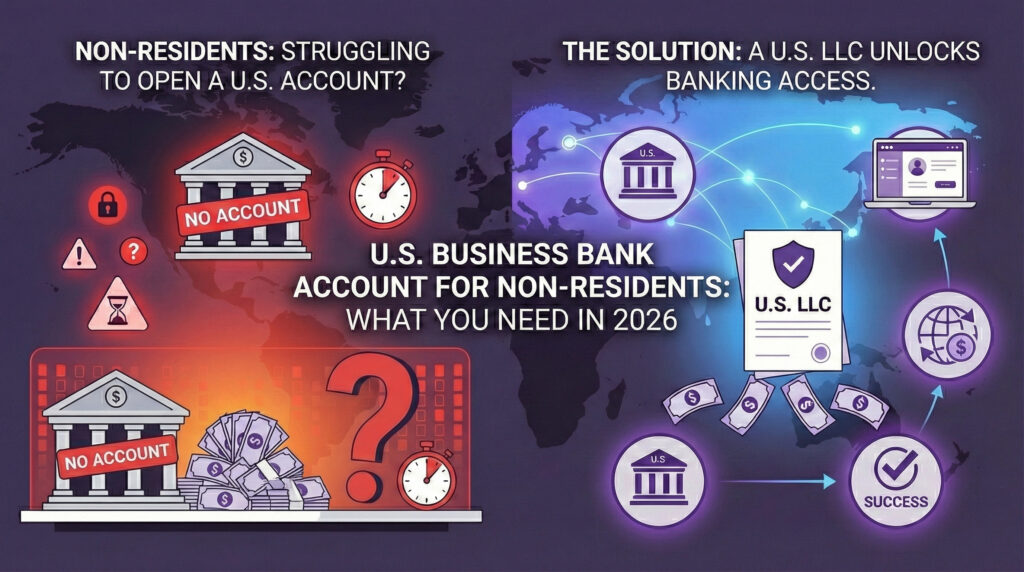
For non-U.S. entrepreneurs, freelancers, and online business owners, opening a U.S. business bank account is often the missing link between making sales and actually accessing their money.
Many non-residents face frozen PayPal balances, rejected Stripe applications, or constant compliance reviews not because their business is bad, but because their banking setup is weak or incomplete.
In 2026, the good news is this:
You can open a U.S. business bank account remotely without traveling to the United States if you do it the right way.
This guide explains exactly what non-residents need, why banks reject applications, and how to get approved smoothly.
Why Non-Residents Need a U.S. Business Bank Account
Operating with a personal or foreign bank account creates serious limitations:
PayPal and Stripe may hold or delay funds
Some platforms reject non-U.S. IBANs
Clients prefer paying U.S. businesses
Currency conversion fees eat profits
Compliance reviews happen more often
A U.S. business bank account, connected to a properly formed U.S. LLC, solves most of these issues by giving your business legitimacy inside the U.S. financial system.
Can Non-Residents Open a U.S. Business Bank Account?
Yes — legally and remotely.
In 2026, several U.S. fintech banks allow non-residents to open accounts 100% online, as long as they meet the basic requirements.
You do not need:
A U.S. visa
A Social Security Number (SSN)
Physical presence in the U.S.
But you do need the correct business structure.
What You Need to Open a U.S. Business Bank Account (Non-Residents)
1. A U.S. LLC
Your bank account must belong to a registered U.S. company.
Most non-residents choose:
Wyoming LLC (strong reputation)
New Mexico LLC (privacy + low cost)
Without an LLC, approval is almost impossible.
2. EIN (Employer Identification Number)
An EIN is the tax ID of your business.
Banks, PayPal, Stripe, and Amazon require it to:
Verify your company
Run compliance checks
Report activity correctly
Non-residents can get an EIN without an SSN.
3. U.S. Business Address & Registered Agent
Banks require:
A real U.S. address (not a P.O. Box)
A registered agent linked to your LLC
This proves your business has a legal footprint in the U.S.
4. Valid Passport
Used for identity verification and KYC (Know Your Customer) checks.
5. Business Description & Website (Highly Recommended)
Banks want to understand:
What you sell
Who your customers are
How you receive payments
A simple, professional website increases approval chances significantly.
Best U.S. Business Banks for Non-Residents (2026)
🔹 Mercury
100% online
No monthly fees
Works well with Stripe & PayPal
Designed for startups and founders
🔹 Relay
Strong compliance reputation
Multiple checking accounts
Ideal for scaling businesses
🔹 Wise (Business)
Hybrid solution
Great for international transfers
Not a full U.S. bank, but useful
Most non-residents start with Mercury or Relay.
Common Reasons Banks Reject Non-Residents
No EIN or incorrect EIN
Inconsistent business information
High-risk business model without explanation
Using personal PayPal/Stripe accounts
No website or unclear activity
Poor LLC setup
A clean structure prevents 90% of rejections.
How a U.S. LLC Makes Banking Approval Easier
A properly formed U.S. LLC:
Matches bank compliance requirements
Separates personal and business risk
Increases trust with payment processors
Reduces account freezes
Unlocks stable, long-term banking
This is why PayPal and Stripe favor U.S. entities over foreign individuals.
Final Thoughts: Banking Is the Foundation
A U.S. business bank account isn’t just about holding money —
it’s about stability, trust, and growth.
If you’re serious about building a global business in 2026, your setup should look like this:
✅ U.S. LLC
✅ EIN
✅ U.S. business bank account
✅ Payment gateways connected correctly
Once this foundation is in place, growth becomes much easier.