
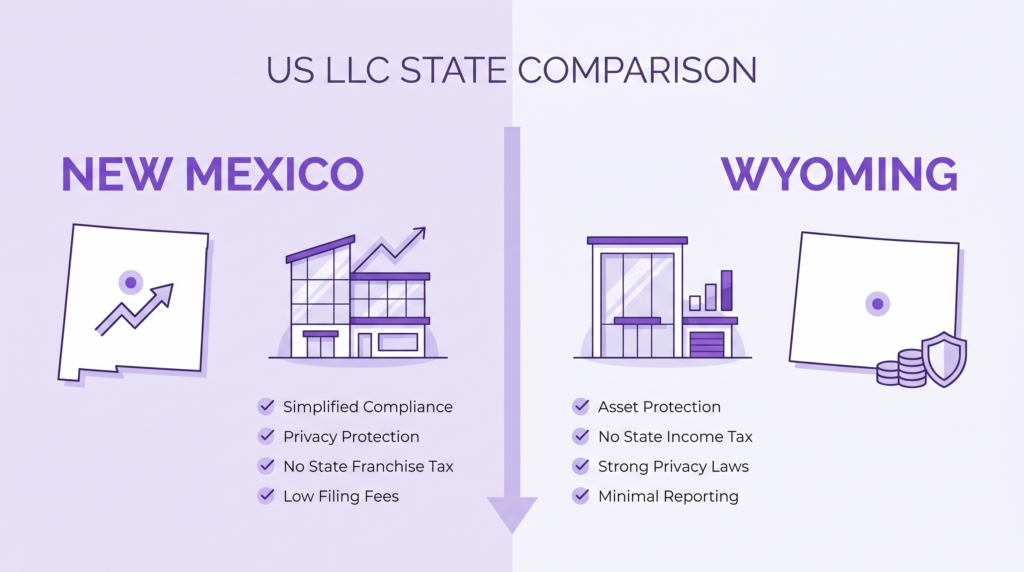
Choosing between a New Mexico vs Wyoming LLC is the first real decision most non-residents face — and the one they overthink the most. Both states let you form a US LLC without living in America, both keep your name off public records, and neither will tax you if you have no US operations.
But they are not identical. One costs you nothing to maintain, forever. The other costs $60 every year but gives you the strongest asset-protection law in the country. This guide compares New Mexico vs Wyoming LLC formation on cost, privacy, asset protection, taxes and annual paperwork — with a clear recommendation for each type of business.
Table of contents
- The short answer
- New Mexico vs Wyoming LLC: side-by-side
- Cost over ten years
- Privacy compared
- Asset protection
- Taxes for non-residents
- Annual maintenance
- Which fits your business?
- Three common mistakes
- What about Delaware or Florida?
- What your state choice does not change
- How to form your LLC
- Frequently asked questions
The short answer
For most non-residents running an online business — freelancing, consulting, e-commerce, SaaS, agencies — New Mexico is the better choice. It is the only state with no annual report and no franchise tax, so your ongoing state cost is genuinely $0 per year, forever.
Choose Wyoming instead if you are holding valuable assets in the company, expect meaningful legal exposure, or want the most battle-tested LLC statute in the US. The $60 a year buys you a stronger legal shield, not a better company.
New Mexico vs Wyoming LLC: side-by-side
| New Mexico | Wyoming | |
|---|---|---|
| State filing fee | $50 (one-time) | $100 (one-time) |
| Annual report | None — ever | $60/year minimum |
| Franchise tax | None | None |
| Ongoing state cost | $0/year | $60/year |
| Members on public record | No | No |
| Registered agent required | Yes | Yes |
| State income tax (non-resident, no US operations) | $0 | $0 |
| Asset protection strength | Good | Strongest in the US |
| Formation speed | A few business days | A few business days |
| Accepted by Stripe, PayPal, Amazon, banks | Yes | Yes |
New Mexico LLC vs Wyoming LLC: cost over ten years
This is where the two states genuinely separate, and it compounds over time. The filing fee is a one-time cost you will forget about. The annual cost is the one that matters.
| New Mexico | Wyoming | |
|---|---|---|
| Year 1 state fee | $50 | $100 |
| Year 2 | $0 | $60 |
| Year 5 (cumulative) | $50 | $340 |
| Year 10 (cumulative) | $50 | $640 |
Over ten years a New Mexico LLC costs you $50 in total state fees. A Wyoming LLC costs $640. Neither figure includes your registered agent, which every state requires and which you pay separately.
One nuance worth knowing: Wyoming’s annual report is technically the greater of $60 or $0.0002 per dollar of assets located in Wyoming. For a non-resident running an online business with no property in the state, that means you pay the $60 minimum.
Privacy: is New Mexico really more anonymous?
Both states are genuinely private, and this is where most articles overstate the difference.
New Mexico does not require members or managers to be named in the Articles of Organization, and there is no annual report — so there is no yearly filing where ownership could surface. This is why New Mexico is often called the most anonymous LLC state in the US.
Wyoming also keeps members and managers off the public formation record. However, Wyoming requires that annual report every year, listing a contact and the principal office. Ownership itself stays private, but you are filing something with the state annually rather than nothing at all.
In practice: both keep your name out of a casual public search. New Mexico’s edge is that there is simply no recurring filing to worry about. If absolute minimum public footprint is your priority, New Mexico wins narrowly.
Worth adding: since 2025, BOI reporting to FinCEN is no longer required for US-formed LLCs, which removed the federal ownership-disclosure step entirely for both states. We cover the current rules in our 2026 BOI reporting guide.
Asset protection: where a Wyoming LLC vs New Mexico LLC actually differs
This is the one category where Wyoming is clearly, substantively better — and the honest reason to pay the $60.
Wyoming law makes the charging order the exclusive remedy for a creditor who wins a judgment against an LLC member. In plain terms: a creditor can be assigned your share of distributions, but cannot seize your membership interest, cannot force the company to make distributions, and cannot take over management. Wyoming also extends this protection explicitly to single-member LLCs, which many states do not.
New Mexico offers standard LLC liability protection — your personal assets are separated from company liabilities — but its statute and case law are less developed on this specific point, particularly for single-member LLCs.
Does this matter for you? For a freelancer invoicing clients or a store selling digital products, realistically no. For someone holding real estate, equipment, intellectual property or significant retained cash inside the company, it can matter a lot.
Taxes for non-residents: identical in both states
Neither New Mexico nor Wyoming will charge you state income tax if you are a non-resident with no physical presence, no employees and no offices in that state. Wyoming has no personal or corporate income tax at all. New Mexico has both, but they apply to income actually earned within New Mexico — which does not describe a foreign-owned online business.
So on state tax, this is a genuine tie. Do not let anyone sell you Wyoming on “no state income tax” as though New Mexico would tax you — for your situation, both are zero.
What you actually owe at the federal level is a separate question, and it does not change with your state. Our non-resident LLC tax guide explains when US federal tax applies and when it does not.
Annual maintenance: what you actually have to do
| Obligation | New Mexico | Wyoming |
|---|---|---|
| State annual report | None | Every year, $60 |
| Registered agent | Required, paid yearly | Required, paid yearly |
| IRS Form 5472 + pro forma 1120 | Required | Required |
| BOI report (FinCEN) | Not required | Not required |
Miss Wyoming’s annual report and your LLC eventually falls out of good standing and can be administratively dissolved. New Mexico has no such deadline, which is genuinely one less thing to forget when you are running a business from another continent.
Wyoming vs New Mexico LLC: which fits your business?
Choose New Mexico if you are…
- A freelancer, consultant or agency invoicing international clients
- Running an e-commerce store, dropshipping business or digital product brand
- Building a SaaS or online education platform
- Keeping most profit out of the company rather than accumulating assets in it
- Optimising for the lowest possible lifetime cost and the least admin
Choose Wyoming if you are…
- Holding real estate, vehicles, equipment or valuable IP inside the LLC
- In a field with real litigation exposure
- Accumulating significant cash inside the company
- Planning a holding structure with subsidiaries
- Willing to pay $60 a year and file on time for a stronger legal shield
If you are torn, ask one question: would losing what is inside this company hurt badly? If yes, Wyoming. If the company is mostly a payment rail and a legal wrapper for your work, New Mexico.
Three mistakes people make choosing between these states
1. Paying for asset protection they will never use
Most people comparing an LLC in New Mexico vs Wyoming pick Wyoming because “asset protection” sounds important. If your company holds a laptop and a Stripe balance you withdraw monthly, charging-order protection is a shield you will never need to raise. Pay the $60 when you have something to protect.
2. Believing the state changes their tax bill
It does not. Your federal position is set by where you live, where you work and whether you have US presence — never by which of the fifty states you filed in. Two identical businesses in New Mexico and Wyoming owe exactly the same US tax.
3. Forgetting Wyoming’s deadline
Wyoming’s annual report is due on the first day of your LLC’s anniversary month. Miss it repeatedly and the state can administratively dissolve your company — which means losing your bank account and payment processing along with it. If you know you are bad with deadlines, New Mexico removes the risk entirely.
What about Delaware or Florida?
Delaware is the reflex answer for people who have read about startups, and it is usually wrong for non-residents. Delaware charges $300 every year in franchise tax on top of a $110 filing fee. That prestige buys you nothing with Stripe, PayPal, Amazon or a business bank — they treat all fifty states identically. Delaware genuinely makes sense when you are raising venture capital from US investors who expect Delaware corporate law, which is a different situation entirely.
Florida is popular but publishes member information and charges $138.75 annually, so it fails the privacy test that draws most people to New Mexico or Wyoming in the first place.
What your state choice does not change
It is worth being blunt about this, because state choice gets far more attention than it deserves. Choosing New Mexico or Wyoming has no effect on:
- Getting an EIN — the process is identical either way, and no SSN is needed. See how to get an EIN without an SSN.
- Opening a US bank account — Mercury, Wise and Relay do not care which state you picked. Our bank comparison covers the real differences.
- Getting approved by Stripe or PayPal — approval depends on your business model and documentation, not your state. See opening Stripe as a non-resident.
- Your IRS obligations — Form 5472 and the pro forma 1120 are federal and apply in every state, with a $25,000 penalty for missing them.
- Your total cost of running the business — the difference between these two states is $60 a year. Our full cost breakdown shows where the money actually goes.
How to form your LLC in either state
- Pick your state using the guidance above — it takes five minutes, not five days.
- Choose a company name and check it is available in that state.
- Appoint a registered agent with a physical address in the state. Non-residents cannot act as their own.
- File the Articles of Organization and pay the state fee.
- Get your EIN from the IRS — no SSN required, typically a few weeks by fax for non-residents.
- Open your US bank account, then apply for Stripe or PayPal.
- Calendar your compliance — Form 5472 every April, plus Wyoming’s annual report if you chose Wyoming.
Our complete formation guide walks through every step in detail.
Frequently asked questions
Is a New Mexico or Wyoming LLC better for a non-resident?
New Mexico is better for most non-residents running online businesses, because it costs $0 per year to maintain and requires no annual filing. Wyoming is better if you hold valuable assets in the company and want the strongest charging-order protection available.
Which is cheaper, a New Mexico or Wyoming LLC?
New Mexico. It costs $50 to file and nothing thereafter. Wyoming costs $100 to file plus $60 every year. Over ten years that is $50 versus $640 in state fees.
Is Wyoming more private than New Mexico?
They are very close. Neither publishes member names on the formation documents. New Mexico has a slight edge because it has no annual report at all, so there is no recurring filing with the state.
Do I pay state taxes in New Mexico or Wyoming as a non-resident?
No, in both cases — assuming you have no physical presence, employees or offices in that state. Your federal obligations are unaffected by which state you choose.
Can I change my LLC’s state later?
Yes. You can either form a new LLC in the other state and move operations across, or in many cases file a domestication to move the existing entity. Both cost time and money, so it is worth choosing sensibly upfront — but this is not a permanent trap.
Does my state choice affect Stripe or bank approval?
No. Stripe, PayPal, Mercury, Wise and Relay treat every US state the same. Approval depends on your business model, your documentation and the consistency of your details.
Do I need a registered agent in both states?
Yes. Every US state requires an LLC to maintain a registered agent with a physical address in that state, and as a non-resident you cannot serve as your own.
Ready to form your US LLC?
Whichever state you pick, the process is the same and we handle all of it — formation, registered agent, EIN without an SSN, and guidance through your bank and Stripe applications. Most clients are up and running in a few weeks.
Still not sure which state fits? Message us on live chat or WhatsApp — we will tell you honestly, even when the cheaper option is the right one.