
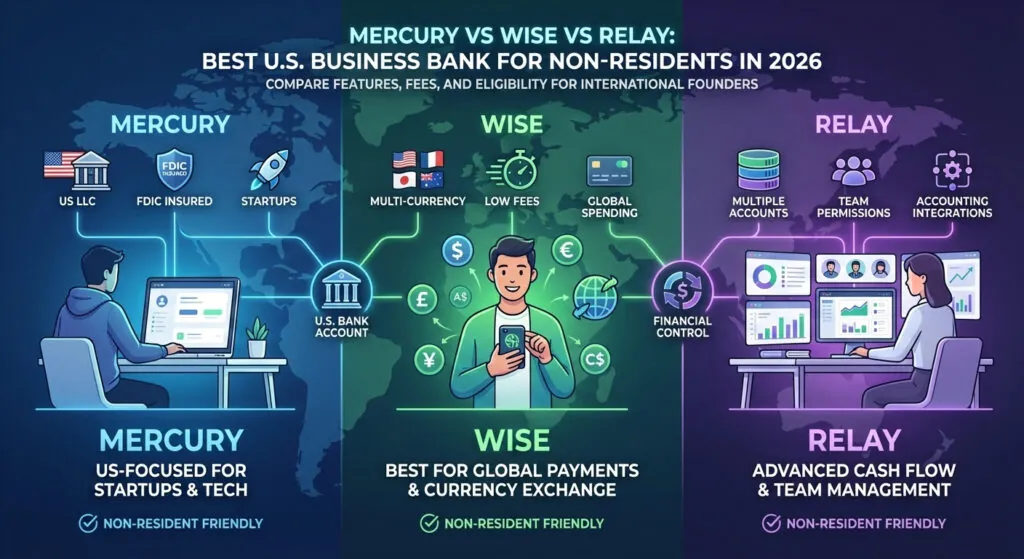
Mercury vs Wise, short answer: if you live in a country Mercury accepts, open Mercury as your main US business account and add Wise for cheap transfers home. If Mercury doesn’t serve your country of residence, Wise is usually the next step, and Payoneer is the fallback that works in the most places, especially for Amazon and freelance platform payouts. Many founders end up using two of the three.
This Mercury vs Wise guide also covers Payoneer, because each of the three has its own list of countries it won’t serve, and that list, not your passport, decides most applications. Fees, documents and eligibility below are as of October 2026.
Mercury vs Wise vs Payoneer: what each one actually is
Mercury is a US fintech company. It isn’t a bank itself; deposits are held at partner banks (Choice Financial Group and Column N.A., both FDIC members). You get a real US checking account with account and routing numbers, debit cards and free USD wires. It’s built to be your main operating account.
Wise Business is a licensed money services business, not a bank. Its strength is currencies: you hold and convert money at close to the mid-market rate. For a US LLC, it gives USD account details that work for ACH and wire payments.
Payoneer is a cross-border payments platform. It gives you USD receiving details that marketplaces and clients pay into, then lets you withdraw to a bank at home. It’s built for getting paid by platforms, not for running your whole business.
What about Relay? Relay now asks every beneficial owner for a physical US residential address, so it’s usually not an option if you live abroad. We no longer recommend it to non-resident founders.
Mercury vs Wise vs Payoneer comparison table (2026)
Figures come from each company’s public pricing and help pages at the time of writing. Fees change, so check before you decide.
| Mercury | Wise Business | Payoneer | |
|---|---|---|---|
| What it is | Fintech with US partner banks (FDIC-insured through them) | Money services business, not a bank | Cross-border payments platform, not a bank |
| Who can open | US companies, including founders living abroad, except residents of Mercury’s prohibited countries | US companies with a real trading address in a supported country; some residences can’t get USD details | Very wide country coverage; check your country during sign-up |
| Main documents | Articles of Organization, EIN letter, passport for each 25%+ owner, real home address, business description | Articles, EIN, passport, proof of trading address, business details | Company details, ID, address verification; documents vary by country |
| US account and routing numbers | Yes, a full US checking account | Yes, USD account details (if your country is eligible) | Yes, USD receiving account details |
| Monthly fee | $0 base plan; paid plans optional | No monthly fee; one-time $31 setup fee in the US | No monthly fee; $29.95 yearly account fee if you receive under $6,000 in 12 months |
| Receiving USD | Free ACH and wires | Domestic USD free; $6.11 per incoming USD wire or Swift payment | Varies by marketplace; up to 1% from clients into a non-local-currency account |
| Sending wires | Domestic and international USD wires $0 | Low fixed fee plus conversion fee | Up to 1% plus a small fixed fee to other countries |
| Currency conversion | 1% on non-USD wires | From about 0.23%, depending on currency | 1.2% to 4% on withdrawals with conversion |
| Cards | Free debit cards; 3% fee on non-USD card payments; physical cards not mailed to some countries | Business card; spending in a currency you hold is free | Optional card, $29.95 per year; up to 3.5% with conversion |
| Best for | Main account, Stripe payouts, US clients | Moving money home, multi-currency clients and suppliers | Amazon, Upwork, Fiverr and other platform payouts |
Mercury vs Wise for non-resident LLC owners: country eligibility
This is where most Mercury vs Wise comparisons go wrong. Both judge you by where you live, not by your citizenship. A Syrian citizen living in Germany may be fine; a German citizen living in Syria will not be.
Countries Mercury doesn’t serve
Mercury’s prohibited countries list (updated October 2026) covers sanctioned places such as Cuba, Iran, North Korea and the Russian-occupied regions of Ukraine, plus a longer list of prohibited countries. For our readers, the important names on that list are:
- Middle East and North Africa: Iraq, Lebanon, Libya, Palestine, Sudan, Syria, Yemen
- South Asia: Pakistan, Bangladesh, Afghanistan, Nepal, Bhutan, Maldives
- Africa: Nigeria, Cameroon, Angola, Mozambique, Zimbabwe, Somalia, South Sudan and several others
- Elsewhere: Indonesia, the Philippines, Vietnam, Ukraine, Russia, Uzbekistan and others
Egypt, Saudi Arabia, the UAE, Jordan, Morocco, Algeria, Tunisia, Turkey and India were not on the list at the time of writing. That doesn’t guarantee approval, and the list changes, so check it on the day you apply.
One more detail: Mercury currently doesn’t mail physical cards to some countries that it otherwise serves (for example Algeria, Morocco, India, Kuwait and Sri Lanka are on its card-mailing restriction list), and shipments to several Gulf countries were paused at the time of writing. Virtual cards still work, which covers most online spending.
Where Wise can and can’t help
Wise’s own list of unsupported locations includes Iraq, Libya, Sudan, Syria, Yemen, Iran and Afghanistan. Lebanon and Palestine are not on it, so residents there may be able to use Wise even though Mercury is closed to them.
There’s a second catch. Wise’s help centre says a US business can’t get USD account details if the business address or the owner’s personal address is in Bangladesh, Cameroon, China, Nigeria or Pakistan. Its general list of places without USD details is longer and also names Türkiye, the UAE and Sri Lanka, so if you live in one of those, confirm with Wise before you rely on it for US payments.
Payoneer: the widest net
Payoneer doesn’t publish one simple country list, but it serves a very wide range of countries, including many that Mercury and Wise don’t cover for USD. It won’t serve sanctioned places. Test your country on its sign-up page, and read its fee schedule first.
What to do if Mercury rejects you
First, read the rejection reason. It usually falls into one of two groups.
If the reason is your country of residence, reapplying won’t change anything. Move on:
- Try Wise Business if your country is supported and eligible for USD details (for example Lebanon, Palestine, Egypt, Morocco and many others at the time of writing).
- Use Payoneer if you live in Pakistan, Bangladesh, Nigeria or another country that both Mercury and Wise exclude for USD. It’s the most realistic option for platform income.
- Look at other fintechs that open accounts for foreign-owned US companies. Each has its own country list, so check it before you apply.
- Consider a traditional US bank only if you can travel to the US and open in person. It takes more time and isn’t guaranteed.
If the reason is your application (unclear business, weak website, wrong address), fix the problem and reapply or contact support. The next section covers the usual mistakes. We also wrote a full guide on what to do when your LLC bank account is rejected because of the address.
Why applications get rejected (and how to avoid it)
1. The wrong address
Mercury asks for a physical address where each owner actually lives, and it doesn’t accept registered agent addresses, PO boxes, UPS Store boxes or virtual mailboxes. Wise says the same about trading addresses: no virtual offices, mail-forwarding services or registration agents. Use your real home or office address abroad and make sure it matches your other documents. If you need a genuine US business location, a real lease agreement as proof of business address is very different from a mail drop.
2. Living in a restricted country
Don’t apply with a temporary address abroad while you actually live in a restricted country. Mercury has said it looks at the addresses you give during onboarding and later reviews, as well as where account activity happens. Accounts opened this way can be closed later, often with funds held during the review.
3. A vague business description
“Online business” or “consulting” tells the reviewer nothing. Say what you sell, who your customers are, where they are, and how money comes in. For example: “We build Shopify stores for small retailers in the US and UK; clients pay by invoice through Stripe.”
4. No website or online presence
A simple website with your company name, services, contact email and a privacy page helps a lot. An empty domain raises questions.
5. Missing or mismatched documents
Your Articles, EIN letter and passport must show the same names and spellings. If you don’t have an EIN yet, here’s how to get an EIN without an SSN.
6. A restricted industry
Mercury doesn’t open accounts for money services businesses, crypto exchanges, adult content, cannabis or online gambling. Wise and Payoneer have similar rules.
Mercury vs Wise vs Payoneer by use case
Stripe and online payments
Stripe wants a US bank account in your company’s name. In the Mercury vs Wise choice for Stripe, Mercury is the cleanest option, and Wise USD details are also widely used. Payoneer receiving details are not a dependable choice for Stripe payouts, so don’t build your plan around them. See our guide on how to open a Stripe account as a non-resident.
Amazon FBA and marketplaces
Amazon accepts US bank accounts, and Payoneer is a common choice for marketplace sellers outside the US. Mercury or Wise work too if you’re eligible. If you’re planning a store, read our guide to a US LLC for Amazon FBA.
Upwork, Fiverr and freelancing
Payoneer integrates directly with many freelance platforms, which makes it convenient. Upwork and similar platforms also pay out to US bank accounts, so Mercury or Wise are good options when available. We cover the details in US LLC for Upwork and Fiverr freelancers.
E-commerce and paying suppliers
On Mercury vs Wise for suppliers: if you buy stock from China, Turkey or Europe, Wise is usually cheaper for paying in the supplier’s currency. Mercury charges 1% on non-USD wires and 3% on non-USD card spending, so it’s better for USD payments.
Mercury vs Wise together: the two-account setup
The best answer to Mercury vs Wise is often “both.” A common setup:
- Mercury receives Stripe payouts and US client payments and pays US software and services.
- Wise converts profits to your home currency at a low rate and pays international suppliers.
- Payoneer handles marketplace income if you sell on Amazon or freelance platforms.
Two accounts also protect you: any fintech can freeze an account for a routine review, and a second one keeps your business running meanwhile. Keep invoices for large payments, and never pay personal expenses from the company account.
Before you apply: get the company right
Every option above needs a properly formed US LLC, an EIN and documents that match. If you haven’t picked a state yet, compare New Mexico vs Wyoming; both work for banking. LLC Station’s Builder package includes the LLC formation, the EIN and help preparing your bank application, so the details reviewers check are consistent from day one. You can start your order here.
Frequently asked questions
Mercury vs Wise: which is better for a non-resident LLC?
If Mercury serves your country of residence, it’s the better main account because it’s a full US checking account with free USD wires. Wise is better for converting money and paying people in other currencies.
Does Mercury accept residents of Pakistan, Nigeria or Bangladesh?
Not at the time of writing. All three are on Mercury’s prohibited countries list, which is based on where you live. Wise also doesn’t give USD account details to US businesses with addresses there, so Payoneer is usually the practical option.
Can I open Mercury if I’m from Syria, Iraq or Lebanon but live elsewhere?
Possibly. Mercury says the rule is based on residence, not citizenship, so a citizen of a listed country who lives in a supported country may still be eligible after review.
Is Wise a real US bank account?
No. Wise is a money services business, not a bank. It does give eligible US businesses USD account and routing details that work for ACH and wire payments, which is enough for most clients and platforms.
Can Payoneer replace a US bank account?
For receiving marketplace and freelance income, often yes. For Stripe payouts and everyday business banking, it’s weaker. Treat it as a strong option when Mercury and Wise aren’t available, or as a second account.
Can I use my registered agent’s address for Mercury or Wise?
No. Mercury doesn’t accept registered agent addresses, PO boxes or virtual mailboxes, and Wise doesn’t accept virtual offices or mail-forwarding services as a trading address. Use the real address where you live or work.
Do I need an EIN before applying?
Yes. Mercury asks for your IRS EIN document with your Articles of Organization, and Wise and Payoneer also need your company’s tax ID.
Why not Relay?
Relay now requires a physical US residential address for each beneficial owner, which most founders living abroad don’t have.